Scaling Force Development with VR-Forces, Orchestrate, and Hive
In this guest article, Tom Skelding, Forge Product Manager from Cervus, draws on recent experimentation work to show how teams are complementing traditional wargaming with repeatable, data-driven approaches using Forge, VR-Forces, and Hive.
Wargaming has long played a central role in force development. It gives military staffs a structured way to explore how forces and tactics might perform in different scenarios. But many approaches still rely heavily on expert judgement and manual adjudication, which makes experiments harder to scale, repeat and compare. Today, the pressures on defence experimentation are changing. Teams are being asked to test more variables, answer more complex questions, and produce evidence faster. Decision-makers need more than a compelling discussion; they need results they can use with confidence.
This is where the combination of MAK’s VR-Forces, Cervus’ Forge Orchestrate, and Hive changes the equation.
From simulation-supported wargaming to simulation-centric experimentation
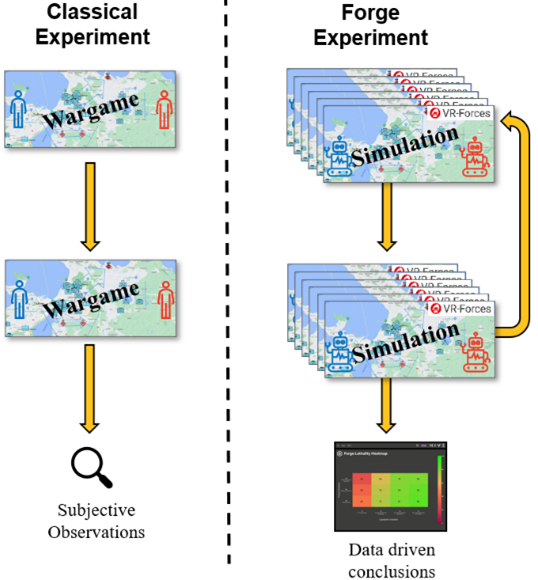
In many simulation-supported wargames, software improves the fidelity of adjudication but doesn’t change the process. Human players still control the key actions and repetition remains resource-intensive. The result is better visualisation and more detailed representation, but not always better experimentation.
Forge takes a different approach. Developed by Cervus to support defence experimentation and force development, it restructures the process around three ideas: automated execution, statistical repetition, and data-driven analysis. Simulation becomes the mechanism for testing hypotheses repeatedly and measuring outcomes objectively.
For experimentation staff, it means exploring more variables within controlled scenarios. For senior leaders, it means conclusions that are based on patterns across many runs, not just a single outcome.
VR-Forces as the simulation foundation
At the heart of this approach is VR-Forces, MAK’s multi-domain computer-generated forces platform. VR-Forces provides the constructive simulation environment in which scenarios are built, entities are represented, and behaviours are exercised across land, air, maritime, and space.
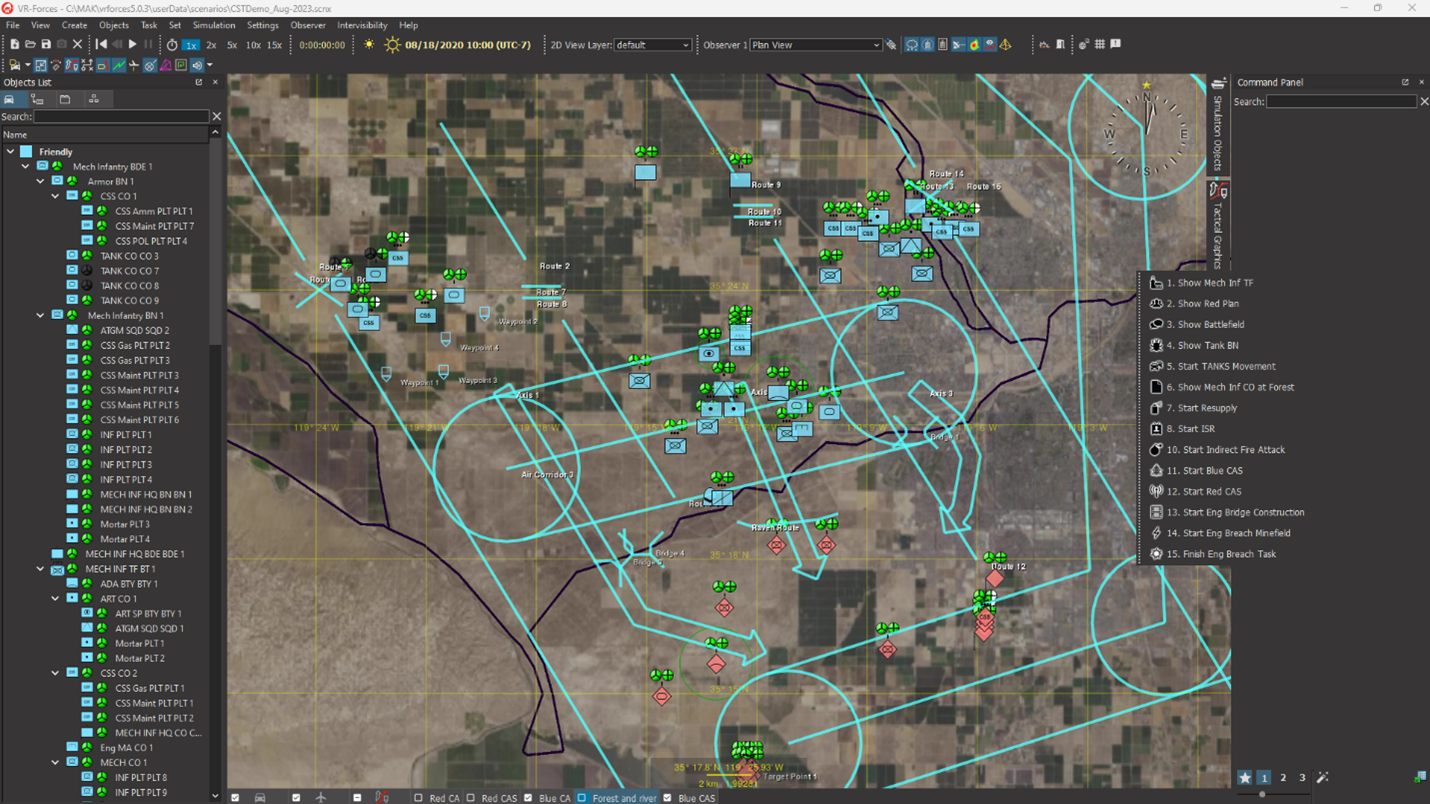
Because VR-Forces can represent platforms, sensors, weapons, and environmental factors at a detailed level, it allows experiment designers to manipulate variables at multiple layers, from force composition and laydown to sensor performance, munition effects, and behavioural parameters.
Instead of just asking “how many?”, VR-Forces lets teams explore also “what mix?”, “under which conditions?”, and “with what trade-offs?”
Equally important, VR-Forces is mature and open enough to support integration. Its plug-in architecture, standards support, and practical interfaces allow tools like Hive to pull data directly from simulation runs, making it a practical backbone for experimentation at scale.
Forge Orchestrate: Turning experimental design into executable evidence
High-fidelity simulation is not enough on its own. The real challenge is running experiments enough times and with enough variation to produce defensible conclusions.
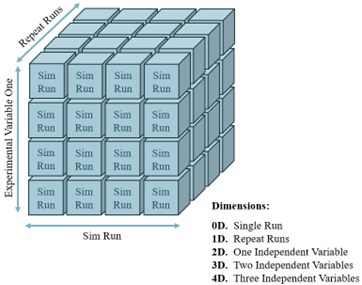
Forge Orchestrate addresses this by enabling large-scale execution across distributed infrastructure. Experiments can be designed as matrices of variables and run in parallel, generating the volume of data needed for meaningful analysis.
This fundamentally shifts the mindset for experimenters because instead of asking whether there’s time to run a few cases, they can design structured experiments with repeated runs and controlled variation. It creates the practical bridge between a good experimental idea and a credible body of evidence.
For decision-makers, this means conclusions that are grounded in trends, highlighting performance patterns, sensitivity to assumptions, and diminishing returns.
Hive: Where experimentation becomes measurable
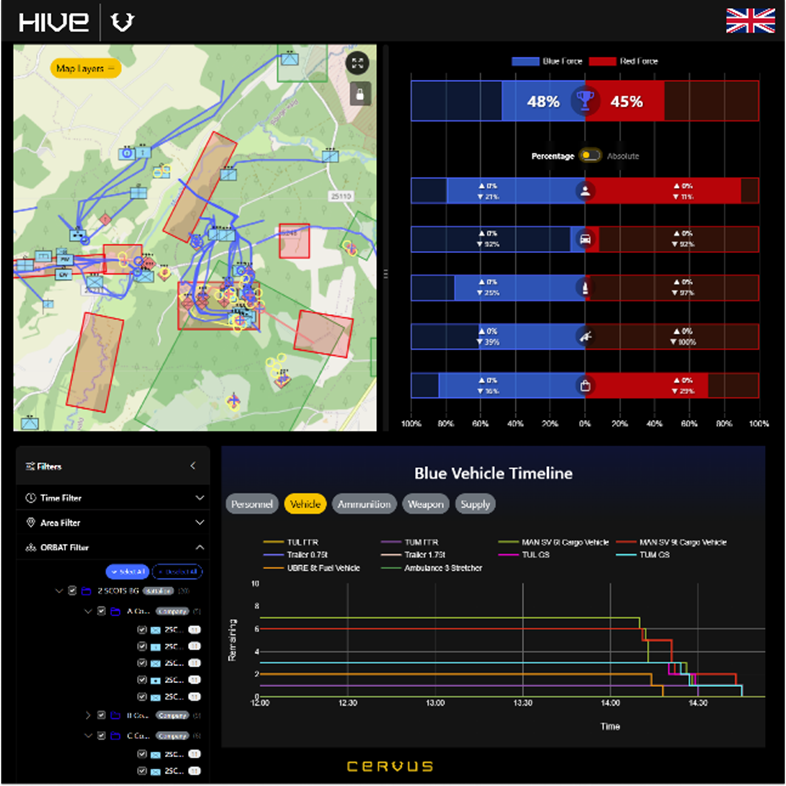
As experiments scale, observation data quickly becomes the bottleneck. Even modest designs can generate more output than analysts can interpret manually.
Hive provides the analytical layer. It ingests simulation data and presents performance metrics through dashboards, charts, and comparative views across runs.
For experimentation teams, this turns raw simulation output into measurable effectiveness and performance in real-time, after action, and comparatively across runs. For senior leaders, it provides visibility into outcomes: where performance improved, where trade-offs emerged, where outcomes were highly variable, and where apparently optimization points were reached.
A practical example: Bounded experimentation at operational scale
A recent experiment describes how this comes together in practice. Cervus used Forge to test how different artillery combinations would perform in a simulated conflict between a NATO corps and an opposing force.
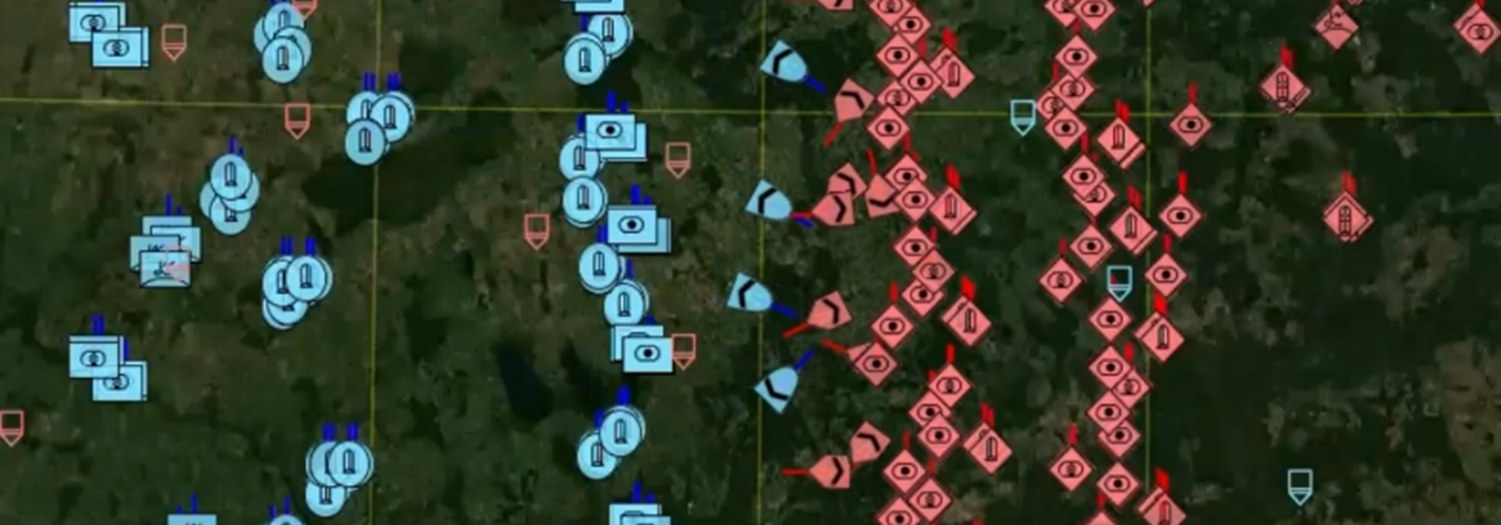
Instead of modeling everything, the scenario concentrated on the parts of the fight that mattered most for this experiment, including artillery, sensors, air defence, and supporting systems.
Once the scenario was set, the system ran it repeatedly with different artillery mixes. These runs were automated, so the simulation could play out without constant human input or intervention. By running many variations in parallel, the team generated a large set of results in a short time, which were then fed into Hive, turning the raw data into something usable.
Instead of reviewing individual runs, analysts could see patterns from the data: what worked, what didn’t, and where adding more equipment stopped making a noticeable difference.
Taken together, this illustrates how the pieces fit:
- VR-Forces provides the simulation environment
- Orchestrate runs the experiments at scale
- Hive makes sense of the results
The outcome is a process that’s faster, easier to repeat, and grounded in data rather than relying on a single run or a subjective assessment.
Complementing (not replacing) wargaming
To be clear, this approach is not a replacement for traditional wargaming. Human-led wargaming remains essential when dealing with ambiguity, strategy, and complex decision-making. Instead, simulation-centric experimentation complements it. Wargaming helps define the question, and simulation helps test the answer under controlled conditions.
Together, they create a more robust pathway from concept exploration to evidence-based decisions.
Why this matters now
Across defence, the demand for faster adaptation is increasing. Force design cycles are under pressure, technology change is accelerating, and militaries are being asked to make more confident capability decisions under tighter timelines. In that environment, tools that combine speed, repeatability, and transparency are critical.
The combination of VR-Forces, Forge Orchestrate, and Hive enables teams to move beyond isolated runs and qualitative debate toward structured, data-driven experimentation. It helps turn “what if?” into measurable evidence, and evidence into better force development decisions.
This guest article was written by Tom Skelding, Forge Product Manager at Cervus.
Reach out to the MAK team for more details or information at