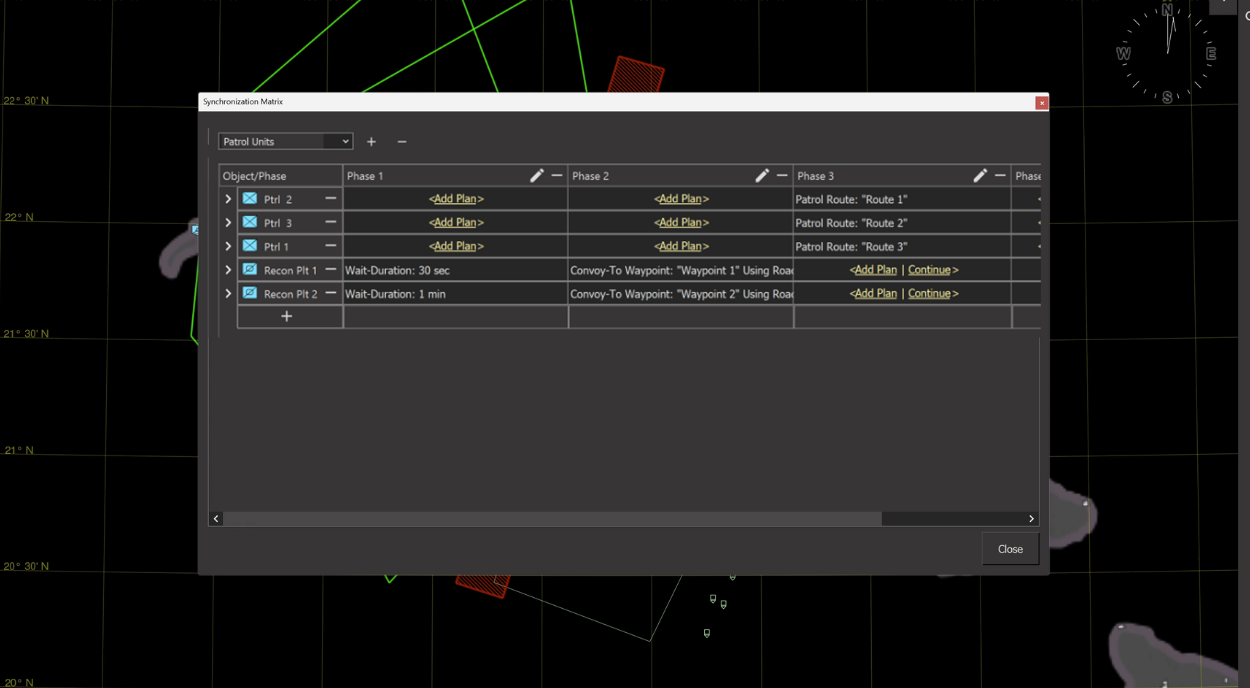
Managing Large-Scale Scenarios in VR-Forces with Sync Matrices
We’re excited to share this guest article by Eliana Saar, a Sales and Support Engineer at Synergy Integration, who outlines her experience supporting a complex, multi-scenario Battle Lab experiment using VR-Forces Synchronization Matrices.
During a recent Battle Lab experiment this past January, I took part as a field engineer from Synergy Integration Ltd., a MAK Technologies distributor specializing in modeling and simulation. I worked closely with the team on-site to support their use of MAK ONE tools, which form the core of their simulation environment.
From the very beginning, it was clear that this would be a complex effort. The experiment itself was built from multiple scenarios, each containing hundreds of entities. These scenarios were executed together- across multiple backends- to form a single, cohesive experiment environment. Because of that, coordination wasn’t just required within a single scenario, but also across scenarios. We knew early on that we needed a structured approach.
Designing for Complexity from the Start
When working at this scale, the challenge isn’t building the behaviors, but rather maintaining control and clarity as the system and scenarios grow. Rather than relying on individual plans scattered across entities, we structured each scenario using Synchronization Matrices. This gave us a centralized way to manage behavior within each scenario, while keeping everything organized and predictable.
Organizing the Scenario
One of the first decisions was how to structure the matrices.
Instead of putting everything into a single matrix, we created multiple matrices based on unit types. For example, vehicles of a certain type, along with the entities assigned to those vehicles, were grouped into the same matrix.
This approach helped us:
- Keep each matrix focused and easy to navigate
- Avoid unnecessary clutter
- Make targeted updates without affecting unrelated parts of the scenario
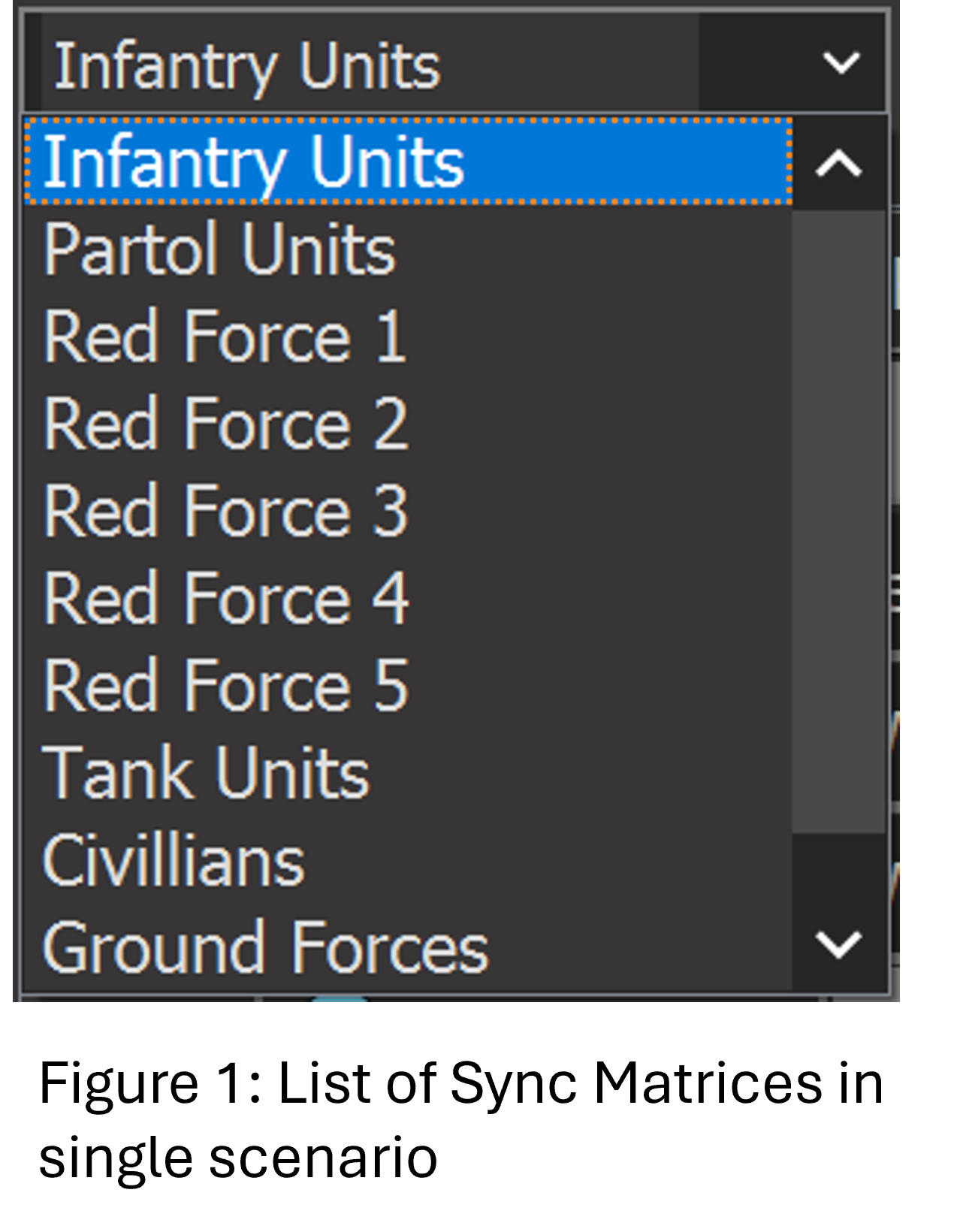
Using the dropdown to switch between matrices made it easy to move between different parts of each scenario as needed.
Structuring Execution with Phases
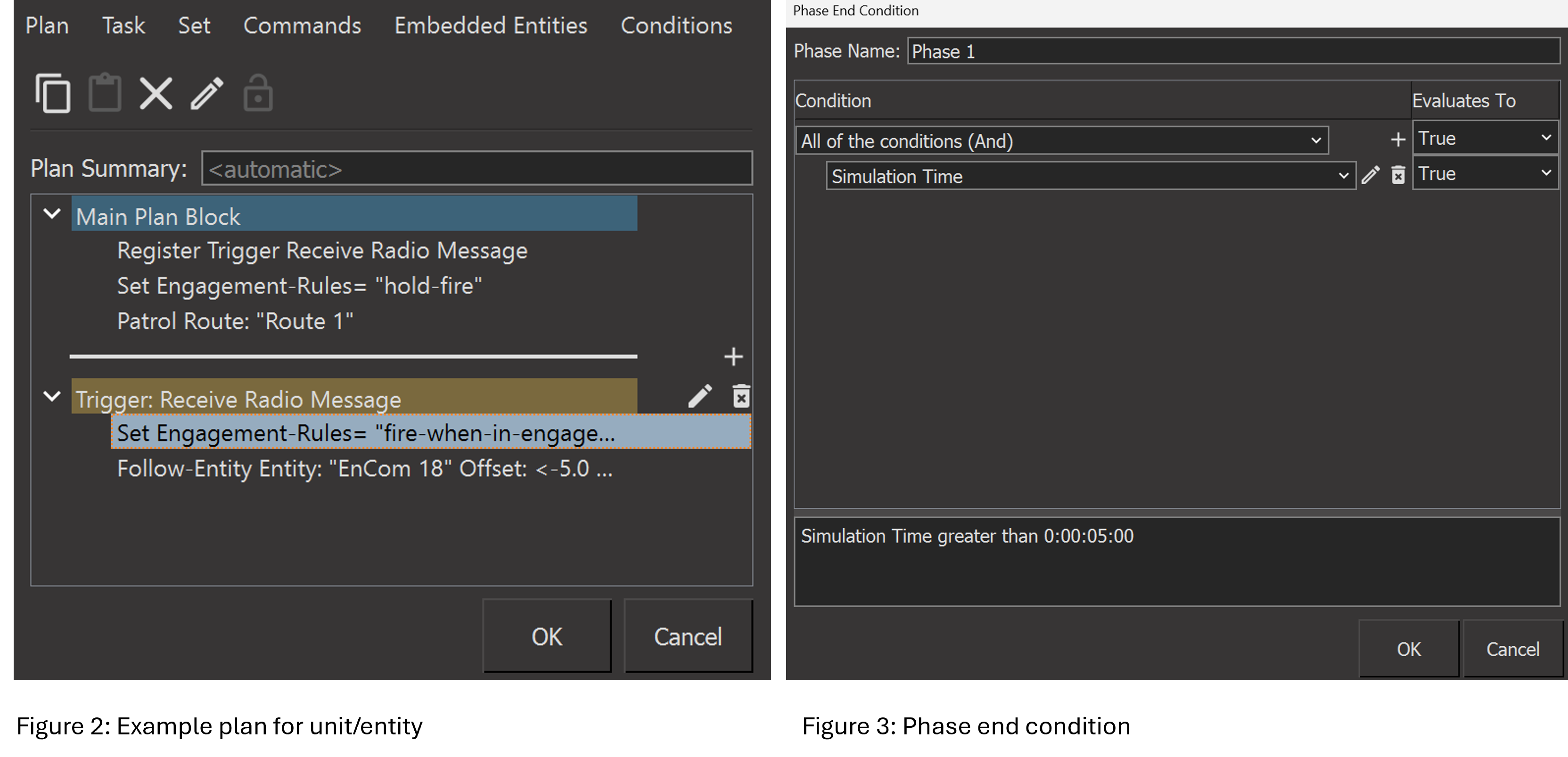
A key advantage of the Sync Matrix is its phase-based structure. We used phases to define the flow within each scenario, with each phase representing a clear step in execution. Each entity or unit had a specific plan within each phase, allowing us to maintain tight coordination.
Phases progress based on defined end conditions, ensuring that all required actions are completed before moving forward. This made behavior more predictable and easier to validate, especially important when multiple scenarios were running together.
Managing Behavior Visually
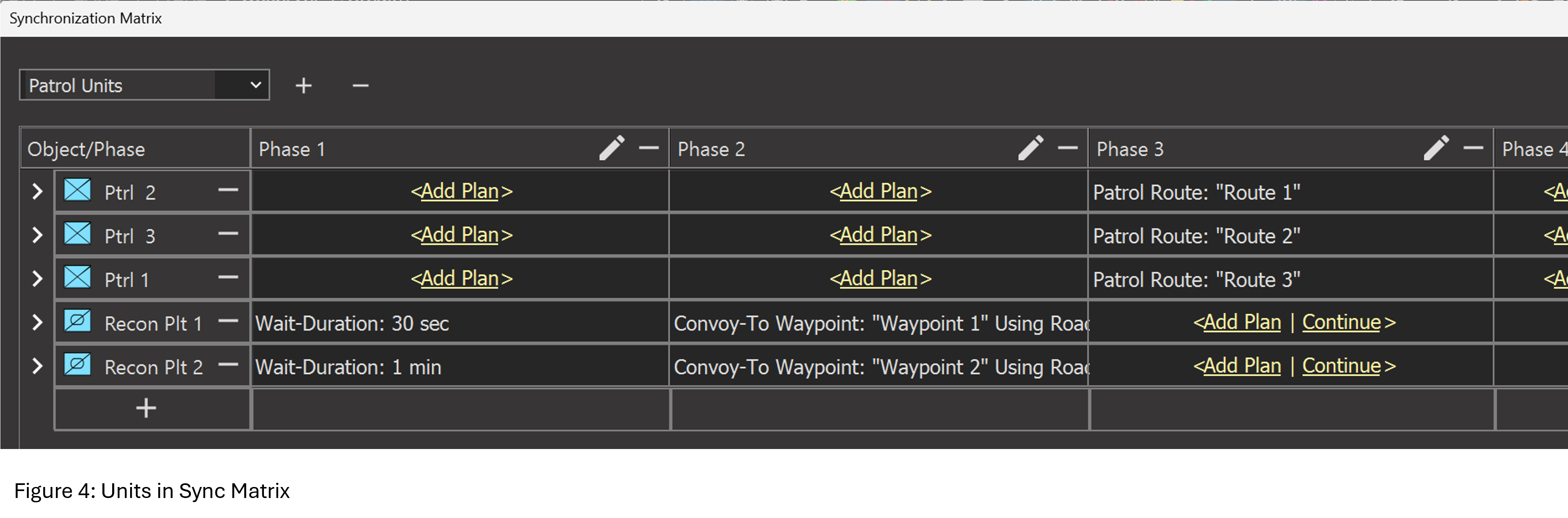
Within each matrix, entities and units are organized in rows, with plans assigned across phases. This layout provided a clear, visual representation of what was happening:
- It was easy to see what each entity was doing at any point
- We could quickly locate and edit specific plans
- It became much simpler to verify that everything was aligned correctly
Instead of piecing together behavior from multiple places, everything was visible in one structured view.
Why This Approach Worked
From a field perspective, the biggest advantage of using Sync Matrices from the start was clarity.
Even as each individual scenario grew, and as multiple scenarios were combined into a single experiment, we didn’t lose control or visibility. The structure was already in place.
This made it much easier to:
- Manage large numbers of entities across scenarios
- Maintain synchronization within each scenario
- Make updates without introducing errors
- Understand and troubleshoot behavior when needed
Final Thoughts
For complex environments, especially those made of multiple scenarios running together, the Synchronization Matrix is more than a simple tool. It becomes a way to structure and manage the entire system. By deciding early to build each scenario around Sync Matrices, we were able to maintain control, clarity, and scalability throughout the experiment.
If you’re planning scenarios with a high level of coordination, it’s worth considering this approach from the very beginning.

This guest article was written by Eliana Saar, Sales and Support Engineer at Synergy Integration, MAK's Israeli distributor. For more info about sync matrices, enjoy this quick 2-min video by Jim Kogler that dives in a little deeper.
Feel free to reach out to the MAK team for more details or information anytime at