
Operational Realism in MAK ONE:
TDL for VR-Forces, TDL Gateway, TDL SDK, AIS for VR-Forces, ASTERIX for VR-Forces
One of the most powerful ideas behind the MAK ONE ecosystem is that users should not have to choose between a flexible synthetic environment and high-fidelity operational realism. MAK ONE’s open standards and open APIs make it possible to integrate best-in-class capabilities without friction. Partners like CogSim Technologies build on this foundation to extend MAK ONE with deep operational realism.
CogSim specializes in enabling Live, Virtual, and Constructive (LVC) training by connecting synthetic environments to real-world tactical networks. Its simulation technologies allow scenarios built within MAK ONE to operate using the same tactical data standards, network protocols, and operational behaviors used by deployed defense systems.
CogSim technologies are used in distributed simulation and training environments, including the Royal Air Force Gladiator program and activities conducted by the Royal Canadian Air Force Aerospace Warfare Centre.
By integrating directly with MAK ONE tools such as VR-Forces, CogSim enables synthetic entities to exchange tactical data, surveillance information, and operational messages using authentic protocols and standards. This allows simulation environments to interact naturally with operational systems while preserving the flexibility and scalability of the MAK ONE platform.
This is the MAK ONE ecosystem in action: MAK ONE provides the open foundation, and CogSim adds deep domain expertise on top of it. Keep scrolling to learn more about what CogSim offers to MAK ONE users.
CogSim Capabilities within the MAK ONE Ecosystem
Tactical Data Link for VR-Forces
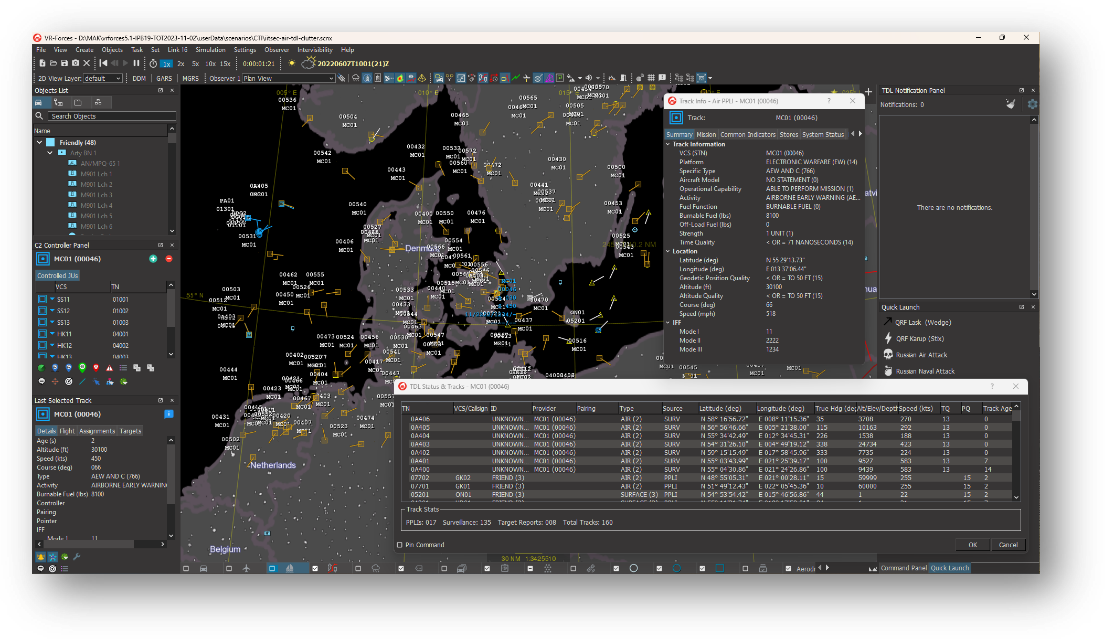
TDL for VR-Forces embeds a simulated Tactical Data Link terminal and mission computer within each TDL-enabled VR-Forces entity. This architecture allows simulated platforms to participate in tactical data networks using the same message formats and interaction rules defined in NATO tactical data link standards.
Rather than simply generating messages, each entity follows the operational logic that governs how tactical information is produced, exchanged, and managed within a tactical network.
The system also allows simulated entities and VR-Forces operators to role-play operational platforms within specific tactical data link mission domains. Depending on the platform type and scenario configuration, VR-Forces entities can represent participants in domains such as:
- Air Battlespace Management (ABM) and airborne early warning
- Ground-Based and Air-Based Air Defence (GBAD / ABAD) networks
- Fighter-to-fighter tactical coordination and air combat operations
- Maritime operations and anti-submarine warfare (ASW) environments
Each simulated platform can therefore participate in the network using the behaviors and message interactions appropriate to its operational role.
You can find TDL for VR-Forces in the following programs:
- UK Royal Air Force Gladiator Collective Training Environment
- Royal Canadian Air Force Aerospace Warfare Centre distributed simulation and experimentation activities
- NATO and national LVC training environments
The TDL for VR-Forces Advantage: This approach enables VR-Forces entities to behave like real tactical network participants, supporting authentic Link-16 interactions and command-and-control workflows directly within the simulation environment while enabling realistic multi-domain training scenarios.
TDL Gateway
The TDL Gateway connects simulation environments to external tactical data link networks, enabling bidirectional exchange of tactical information between synthetic and operational systems.
Within simulation environments, the gateway supports the SISO-J protocol, allowing DIS and HLA federations to exchange J-series tactical data messages. On the operational side, the gateway supports SIMPLE and JREAP-C protocols, enabling interoperability with real-world tactical data link networks and command systems.
You can find TDL Gateway in the following programs:
- RAF Gladiator distributed training environment linking simulation and operational networks
- RCAF Aerospace Warfare Centre distributed mission simulation environments
- Integration laboratories and distributed LVC training architectures
The TDL Gateway Advantage: This architecture allows simulation systems and operational networks to share situational awareness and command-and-control information, enabling realistic Live-Virtual-Constructive training environments without requiring custom integration.
Tactical Data Link Software Development Kit (TDL SDK)
The TDL SDK provides software libraries and developer tools that simplify the integration of tactical data link functionality into new or existing systems. CogSim’s libraries encapsulate the complexity of tactical data link message standards and the rules governing their exchange, allowing developers to focus on system integration rather than protocol implementation.
The SDK supports multiple operational data link standards, including Link-16, Link-22, and Variable Message Format (VMF), along with network protocol support for SISO-J, SIMPLE, and JREAP-C environments.
Program examples: Simulation developers and system integrators adding tactical data link interoperability to custom training systems, mission rehearsal tools, or research environments.
The TDL SDK Advantage: Developers can rapidly add standards-compliant tactical data link interoperability to their systems without implementing complex message sets, network protocols, or operational interaction rules from scratch.
AIS for VR-Forces
AIS for VR-Forces generates standards-compliant Automatic Identification System (AIS) messages based on the behavior of simulated maritime entities within VR-Forces scenarios.
You can find AIS for VR-Forces in the following programs:
- RCAF Aerospace Warfare Centre maritime simulation and experimentation activities
- Naval and maritime domain awareness training environments
AIS for VR-Forces Advantage: Simulation environments can produce realistic AIS traffic streams that can be consumed by operational maritime monitoring systems or integrated with real-world vessel tracking networks.
ASTERIX for VR-Forces
ASTERIX for VR-Forces generates EUROCONTROL-standard ASTERIX surveillance messages derived from simulated aircraft and sensor activity within VR-Forces scenarios.
You can find ASTERIX for VR-Forces in these programs:
- RCAF distributed simulation exercises air surveillance simulation activities
- Radar integration laboratories and air defence training environments
The ASTERIX for VR-Forces Advantage: Synthetic environments can interface with operational radar processing and air surveillance systems using the same data formats used by real-world surveillance networks.
Enabling Operationally Relevant Synthetic Environments
Together, these technologies allow MAK ONE users to create simulation environments that exchange information using the same standards, protocols, and behaviors used by operational systems. This enables more realistic training, experimentation, and system integration without the need for custom middleware or one-off integration projects.
Programs such as the Royal Air Force Gladiator synthetic training environment, which links simulators and training systems into a distributed mission training architecture, demonstrate how commercial simulation technologies can support modern coalition training.
Similarly, the Royal Canadian Air Force Aerospace Warfare Centre supports distributed simulation activities and participates in multinational exercises such as Virtual Flag: Coalition, where allied forces train together in complex live-virtual-constructive environments.
Already in use across defense and research organizations worldwide, CogSim’s technology gives MAK ONE users greater realism and confidence that their synthetic environment aligns with operational reality.
To learn more about CogSim’s high-fidelity simulation interoperability solutions and how they integrate with MAK ONE, contact