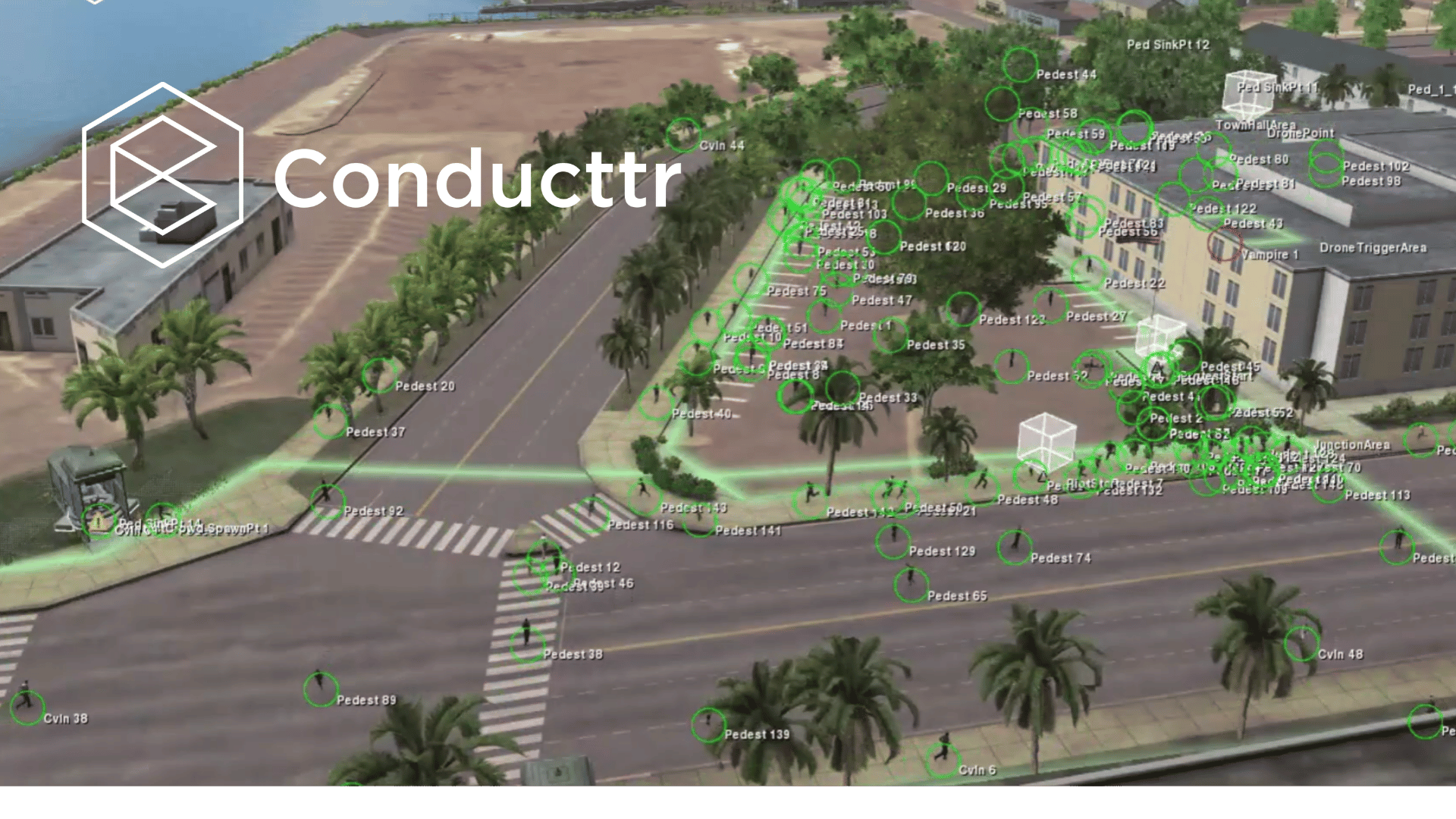
Information Warfare Modeling
Rehearse information operations alongside physical events in a realistic synthetic information environment with Conducttr.
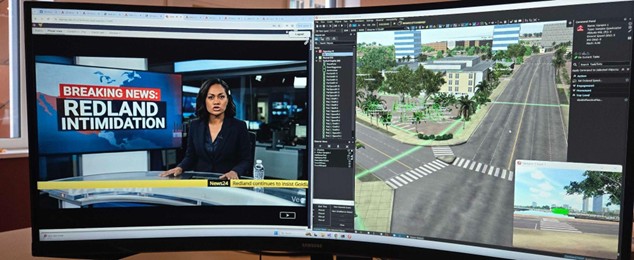
Crises unfold across multiple domains, with physical activity, human perception, media activity, public behaviour, and institutional response all shaping the overall situation. Multi-domain exercising is important because it allows organisations to train in a way that reflects this wider operating environment.
By linking kinetic activity with information effects and audience response, a multi-domain exercise gives the training audience a fuller picture of consequence, escalation, and second-order effects. It helps teams understand how events are interpreted, how narratives spread, how populations react, and how decisions in one domain can influence conditions in another. This supports more realistic training and strengthens judgement, coordination, and preparedness.
Bridging the Physical and Information Environments
To achieve the integration of information and physical worlds, we developed and deployed a Conducttr HLA Federate, a middleware component that bridges the exercise control and simulation domains.
The Conducttr HLA Federate performs two functions:
- VR-Forces-to-Conducttr: it loads a stack of FOMs including Conducttr’s INFO FOM and most notably NET-N Warfare and NETN-Physical. This allows it to connect to the MAK RTI using HLA Evolved and listen for activity in VR-Forces. When it sees activity, it can publish directly to Conducttr (as is the case with the website hack) or can start audience reactions by triggering a pattern-of-life reaction (a “stack” in Conducttr’s parlance).
- Conducttr-to-VR-Forces: it polls the Conducttr master events list for “Narrative Events” and uses this as a cue to use the VR-Forces Remote Control Interface to trigger scenario events inside VR-Forces.
Modeling the Cognitive Reaction
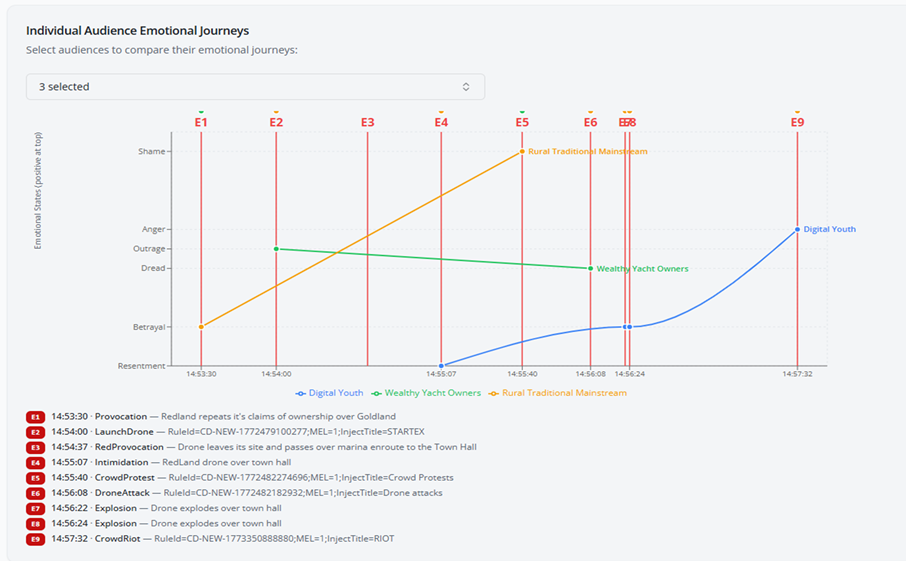
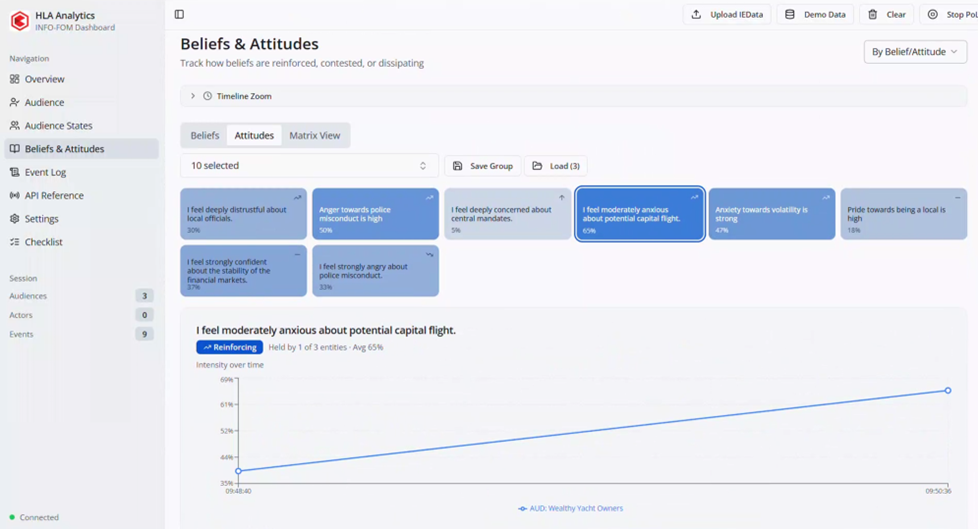
Within Conducttr, audiences are represented by population segments modelled around beliefs, attitudes, and emotional states. As events unfold, the events reinforce or contest audience beliefs & attitudes and these AudienceState changes are published into the RTI via the INFO FOM.
The screenshots below show how the scenario unfolded through the lens of each audience.
From a training perspective, this integration provides a tangible understanding of how civilian populations respond to kinetic activity. This makes the cognitive domain no longer an abstraction but an active, measurable part of the simulation.
Streamlining Integration for Rapid Iteration
Running Conducttr and VR-Forces side-by-side creates an incredibly believable operational environment, much more than any one on its own. However, we needed to create an efficient workflow that allows VR-Forces and Conducttr designers to work at their own pace in their own systems and then join the two systems as the exercise build nears completion.
To support this, we developed an application called the HLA Contract Manager to generate a contract.xml file to act as the glue between the two platforms. Loaded at runtime by the Conducttr HLA Federate, the contract specifies how the federate should react when it receives RTI interactions and object state changes and what it should do when the Conducttr master event list advances.
To get the inputs to the contract file, the HLA Contract Manager imports a MSDL exported directly from VR-Forces and imports a scenario file from Conducttr - these provide the known events, objects, locations, audience etc without having to type them manually and makes it easier to update the file as ideas and the scenario change.
What's next?
By building on VR‑Forces as a mature, standards‑aligned kinetic simulation platform, this integration ensures that training audiences can evolve their cognitive and information‑domain training along side the connect without disrupting existing simulation investments. Conducttr is now working with several clients who use VR-Forces and want this integration for their exercises. This is a live production-ready solution, and we’re already working on the 2.0 in light of all the enthusiasm.
We’re very satisfied to have chosen VR-Forces as the kinetic simulation platform for our multi-domain scenario: the platform offers strong HLA support aligned with NETN FOMs, allowing us to integrate cleanly with the INFO FOM, while its C++ libraries and practical examples enabled us to get up to speed quickly.
This guest article was written by Robert Pratten, Founder of Conducttr. Learn more about our exclusive European distributor, ST Engineering Antycip, who managed this VR-Forces integration here.
Reach out to the MAK team for more details or information at