Unlocking Real-Time Synthetic Aperture Radar (SAR) Simulation: How Modern Physics and Ray Tracing Transform Radar Simulation
RFView® for MAK ONE continues to evolve through MAK's partnership with ISL and the underlying RFView® technology. In this guest article, Dr. Hoan Nguyen, Deputy Division Manager of the RF Digital Engineering Solutions Division at ISL, Inc., takes a closer look at the breakthroughs making real-time SAR simulation faster, more accurate, and more accessible than ever.
With the upcoming release of RFView for MAK ONE 1.2, simulating a 10 km × 10 km SAR image now takes under 10 seconds — a significant advancement in simulation performance. Processing bottlenecks have been eliminated, enabling synthetic data generation to scale in line with real-world operational demands.
Why SAR?
SAR holds several distinct advantages over optical (visual) imaging systems mainly because it generates its own energy, whereas optical systems are passive and rely on reflected sunlight. Consequently, optical systems require daylight and are often blinded by glare on the ocean (sun glint) or completely obscured by heavy topography shadows. SAR, on the other hand, provides its own controlled side-looking illumination and bypasses solar geometric limitations. SAR systems use centimeter-scale microwaves which pass directly through dense cloud covers, heavy rain, fog, and smoke. SAR stands out as a critical tool for all-weather, day-and-night high-resolution imaging.
Why SAR Simulation?
Real SAR data is expensive, hard to schedule, and limited in coverage as they usually come from satellites or specialized aircraft. You can't just task a satellite on demand for any location, weather, or scenario you want. Simulation offers repeatability (rerunning the same scenario with one variable changed, like platform speed or added targets), scale (generating huge, labeled datasets for AI target-recognition training that real, often classified, imagery can't easily provide), and full control over dynamic, networked training exercises where the targets and entities only exist inside the simulation itself. Real data still matters for validating that the physics and visual effects are accurate, but once that's confirmed, simulation lets you go anywhere in the world, on demand, without waiting on or paying for an actual satellite pass or aircraft mission.
ISL’s high-fidelity Synthetic Aperture Radar (SAR) simulation technology bridges the gap between physics and front-line readiness. By precisely modeling real-world environmental complexities—from shadowing, layover, and speckle to Doppler offsets and multi-bounce effects—we deliver hyper-realistic, dynamic SAR imagery in real time.
Why Realistic SAR is Hard to Simulate
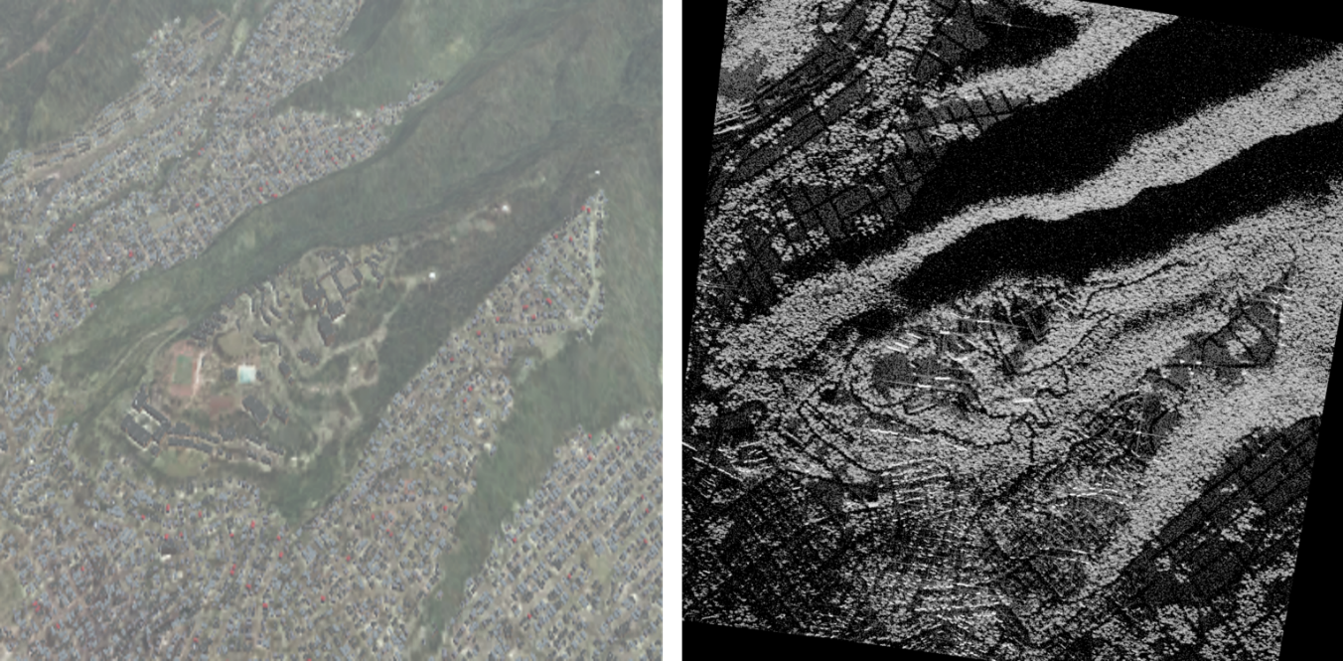
Unlike optical sensors, SAR builds an image from two very different pieces of information: how long a radar pulse took to bounce back (range), and how its frequency shifted based on relative motion (Doppler). The result is closer to a time-frequency plot than a photograph. That difference creates visual effects that don't exist in ordinary imagery:
Shadows appear behind tall objects because there's no return signal from the area they block.
Layover happens because the tops of tall structures are physically closer to the sensor than their bases, so they appear shifted toward the sensor — buildings seem to "lean" toward the radar.
Speckle is a grainy shimmer caused by the radar's coherent waves interfering with each other as they bounce off rough surfaces.
Multibounce occurs when radar energy ricochets off more than one surface before returning, showing up as ghostly energy trailing behind the real object.
Doppler smearing distorts moving vehicles, displacing them in the image in ways that have nothing to do with their actual direction of travel — deeply counterintuitive the first time you see it.
None of this is a flaw in the sensor; it's physics. A SAR simulator has to model radar physics from the ground up and you can't just re-skin a normal 3D renderer and call it done.
Our Approach: Coherent Polarimetric Path Tracing (CPPT)
Interestingly, the breakthrough that made real-time SAR simulation possible didn't come from radar engineering — it came from gaming. Modern GPUs are extraordinarily good at ray tracing: shooting virtual rays into a 3D scene and calculating how light bounces around. It turns out that same machinery, repurposed with the right physics, can simulate radar just as well as it simulates light. Instead of tracing rays of light, we trace rays of radio-frequency energy, tracking their full electromagnetic behavior — phase, amplitude, and polarization — from transmitter, off the terrain and buildings and vehicles, and back to the receiver.
We track waves, not just brightness. Every ray carries four numbers describing its horizontal and vertical polarization state. That's what lets the simulation capture polarimetric effects — how different materials respond depending on wave orientation — without rerunning the whole simulation for each polarization mode.
We sort hits by range and Doppler, not screen position. A normal renderer asks, "which pixel does this ray belong to?" Ours asks, "given this ray's distance traveled and the relative velocity of what it hit, which range-Doppler bin does it belong to?" That reorganization is what turns a 3D scene into something that actually looks like radar output.
We simulate specular and diffuse reflection separately, per material. Smooth surfaces like metal or calm water reflect coherently and can appear almost mirror-bright in the right geometry; rough surfaces scatter energy more evenly. Getting the balance right — conductivity, permittivity, roughness — is what makes buildings, roads, foliage, and vehicles all look distinct and correct.
We simulate thousands of pulses with one pass. Real SAR systems build an image from thousands of pulses collected along a flight path — far too slow to simulate pulse-by-pulse in real time. But since a simulation already knows every object's exact velocity, we can compute the entire range-Doppler picture in a single rendering pass, then apply a mathematical filter that reproduces the blur and the distinctive "cross" pattern real SAR systems create around bright points — all without simulating a single actual pulse.
To learn more about ISL or RFView, visit ISL's website. Click here for more details on RFView for MAK ONE.